Reports Database
Filters
Search keyword
Topic
Report type
Country
Publish year
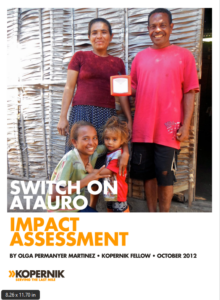
Switch on Atauro Impact Assessment
09/03/2017
“Kopernik connected 200 d.light S250 solar lanterns with families in Biqueli village on Atauro Island, Timor Leste, in partnership with Move Forward (MF), a local NGO. Three out of four sub-villages in Biqueli have no access to electricity. These off-grid communities rely on kerosene lamps, flashlights, and candles at night. In the sub-village where electricity […]
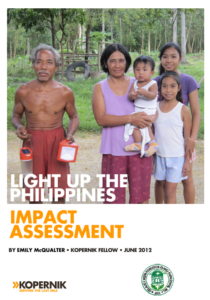
Light Up The Philippines Phase 1 Impact Assessment
09/03/2017
“We connected 408 d.light solar lights with some of the poorest communities in Oriental Mindoro, in the rural Philippines, working with our local partner, the Gelacio I. Yason Foundation Family Farm School Inc (GIYF-FFS). In this region, 80 percent of households have no access to electricity. These off-grid communities are keen to switch from kerosene […]
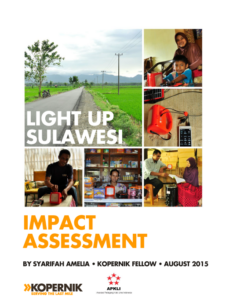
Light Up Sulawesi Impact Assessment
09/03/2017
“The Light Up Sulawesi impact assessment was conducted by Kopernik fellow, Syarifah Amelia, between June and August 2015. This project distributed 50 d.light S300 solar lights in Soppeng district, South Sulawesi from October 2013 to October 2014 in partnership with Asosiasi Pedagang Kaki Lima Indonesia (APKLI). The project originally aimed to target people in villages […]
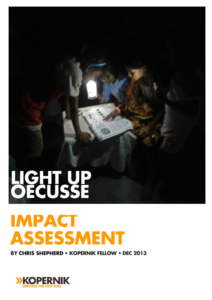
Light Up Oecusse Phase 6 Impact Assessment
09/03/2017
“This impact assessment of d.light solar lights was conducted in Oecusse enclave, Timor-Leste, from May to July 2013. It has been found that the distribution of d.lights in off-the-grid villages in what is Timor-Leste’s poorest and most isolated district is an extremely worthwhile initiative. D.lights offer many immediate benefits in terms of light quality, thus […]
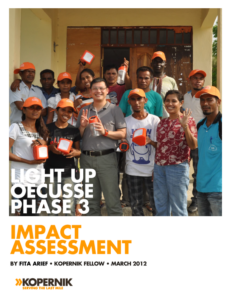
Light Up Oecusse Phase 3 Impact Assessment
09/03/2017
“Kopernik, in partnership with Fundasaun Esperanza Enclave Oecusse (FEEO) made 2,339 more solar lights available in Oecusse in the third phase of the Light Up Oecusse project, 1,316 d.light S250 and 1,023 d.light S10 solar lanterns. Kopernik also teamed up with d.light to design and conduct a training workshop for all FEEO staff members to […]
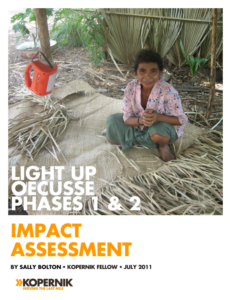
Light Up Oecusse Phase 1 & 2 Impact Assessment
09/03/2017
“Kopernik sent 992 d.light solar lights to Oecusse, Timor-Leste and worked with its local partner, Fundasaun Esperanza Enclave Oecusse (FEEO) to ensure these solar lights reached remote villages in the enclave. Kopernik Fellow Michael Woon (October 2010 – January 2011) designed a baseline lighting survey, and worked with the FEEO team to implement it. Sally […]
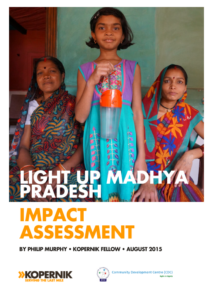
Light Up Madhya Pradesh Impact Assessment
09/03/2017
“Since November 2014, Kopernik in partnership with Community Development Centre (CDC), has delivered over 200 d.light solar lights to last mile communities in rural India as a part of the Light Up Madhya Pradesh project. This project is ongoing and will distribute a further 100 solar lights to households, making a total of 306 solar […]
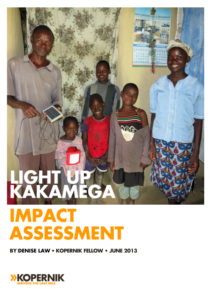
Light Up Kakamega Impact Assessment
09/03/2017
“Kopernik distributed 205 d.light S250 solar lanterns in Kenya’s Western Province in 2012 through a partnership with Action for Child Development Trust (ACDT). Kakamega and Busia counties encompass towns connected to an electricity grid and rural areas without access to electricity. There is a strong demand for solar lanterns in towns, where the electricity supply […]
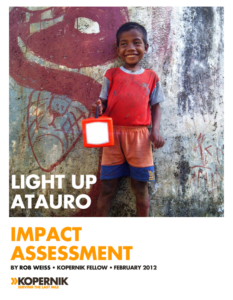
Light Up Atauro Impact Assessment
09/03/2017
“Kopernik made 204 d.light S250 solar lights available to communities in remote parts of Atauro Island, Timor-Leste. Kopernik Fellow, Rob Weiss conducted a 3-week assessment of d.light solar light distribution by local partner Roman Luan. Rob, with the assistance of bilingual (English-Tetum) Roman Luan staff, took a ‘cluster sampling’ approach and conducted 33 interviews with […]
Energy at the Margins
09/03/2017
“The Government of Indonesia is facing significant challenges to provide electricity to its population due to geographic and financial constraints. Off-grid solutions provide the potential for electrification in remote and sparsely populated areas. Solar lanterns are one example of an alternative lighting device for domestic consumption in remote communities. This report was created as part […]
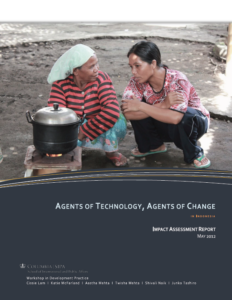
Agents of Technology, Agents of Change Impact Assessment
09/03/2017
“Indonesia’s rural population faces significant challenges in accessing cooking fuels. The use of open fires and inefficient cookstoves degrades the environment as well as causes detrimental health effects for households. Poor households face substantial time and cost burdens from purchasing or collecting wood to use with traditional cooking methods. Additionally, the Indonesian government’s progressive reduction in kerosene subsidies makes […]
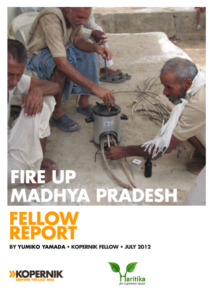
Fire Up Madhya Pradesh Impact Assessment
09/03/2017
“Kopernik partnered with local NGO, Haritika to distribute Greenway Smart Stoves in Madhya Pradesh, India. The cook stoves were made available at a subsidized rate of Rs.500 (US$9). Those from lower income families were given the option of paying this amount in installments. More than 80% of customers live on a monthly income below Rs.6,000 (US$108). The Greenway Smart […]
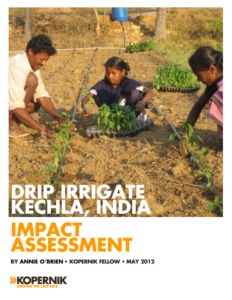
Drip Irrigate Kechala Impact Assessment
09/03/2017
“Kopernik introduced drip irrigation to 55 households in Kechla, India. Kechla and the surrounding communities are located in rural Orissa (an eastern state of India) in the KBK (Kalahandi-Bolangir-Koraput) triangle known to be one of the poorest areas in India. We partnered with AuroMira Service Society (AMSS), a Delhi-based NGO to deliver the Driptech micro-chip irrigation system. Drip irrigation […]
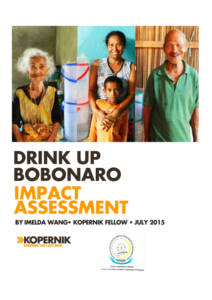
Drink Up Bobonaro Impact Assessment
09/03/2017
“The Drink Up Bobonaro project in Timor-Leste started in August 2014 when Kopernik partnered with local partner, Hemetin Asaun Dezenvolvimento Edukasaun no Ekonomia Rural (HADEER), to distribute 480 Nazava water filters in Bobonaro district. The Nazava ceramic water filters remove microorganisms from the water and reduce the level of harmful chemicals, such as pesticides and chlorine. After filtration, the water […]
Samaritans Wales Impact Report 2015/2016
09/03/2017
“In Wales, between 300 and 350 people die from suicide each year. While causes of suicides are complex, we do know that there are factors which increase the risk for specific groups and individuals. These factors include poor mental health, deprivation, gender and alcohol misuse. Suicide is now the single biggest killer of men aged under 45 in the UK, […]
Thread 2016 Impact Report
09/03/2017
“Thread builds responsible, transparent supply chains from Ground to Good™. We invest heavily in the first mile of our supply chains – the individuals and areas where plastic bottles are picked up from the ground. The first mile of supply chains is an area often ignored and as a result, this portion of supply chains tend to cause […]
The Social Impact of Fair for You: Second Report
09/03/2017
“Fair for You is a registered charity which makes loans to low income households through its lending subsidiary, Fair for You Enterprise CIC. The lending subsidiary is a form of social enterprise, which began making unsecured loans for the purchase of household items available from its ‘online high street’ in December 2015. The loan product provides a real […]
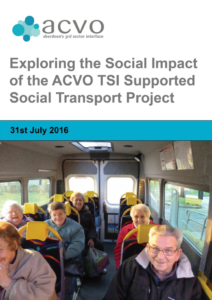
Exploring the Social Impact of the ACVO TSI Supported Social Transport Project
09/03/2017
“What does the STP do? It helps Aberdeen City residents (aged 55 years and over who can’t use regular public transport) to improve and maintain their quality of life It does this by helping them access health and social care in the city It provides a door-to-door, more accessible service, charged at a maximum return […]
Women Make Music Evalution 2011-2016
09/03/2017
“Women Make Music is a PRS Foundation initiative launched in 2011 in response to the low representation of professional female songwriters and composers in the UK. In 2011, only 13% of PRS for Music members were women and 16% of applications for commissions received by PRS Foundation featured female composers and songwriters. Women Make Music grants are available to any female music creator, […]
Impact Tulsa 2016 Community Impact Report
09/03/2017
“Ensuring our kids develop the academic skills and intellectual curiosity they need to be successful adults is not solely the obligation of schools. It is the biggest and most important responsibility of the entire community. Students and educators need support from families, businesses, organizations, civic entities, and faith groups. Learning is a continuous process that […]